
Milton Chakma, Organizer, UPDF, Khagrachari
In the 1980s the situation in the Chittagong Hill Tracts was extremely dire, and the Jana Samhati Samiti (JSS) was cornered on all sides. About 60,000 hill people had taken refuge in India’s Tripura state to escape attacks by the military and settlers. Those who remained in the country were confined in concentration-camp–style settlements called “Baro Gram” (Grand village) “Adrasha Gram” (Model villages),” and “Shanti Gram” (peace villages), from which no one could move without army permission.
To suppress the Shanti Bahini’s armed struggle, the army created vigilante groups such as the Lion Bahini, Tiger Bahini, and GaPraKa (Gana Pratirodh Committee, commonly called the “Gugruk Bahini” by locals). Their unchecked brutality made life unbearable, yet the JSS completely failed to contain them.
The Bangladesh government announced elections for the local government councils of the three hill districts to be held on 25 June 1989. The JSS opposed the elections and pledged to resist them. But the JSS leadership failed miserably to stop the polls. This caused deep frustration within both the Shanti Bahini and the general population. Refugees began fleeing the camps in Tripura and returning to the CHT in large numbers. The JSS leadership was unable to prevent this. Meanwhile, Shanti Bahini members, having lost confidence in the JSS leadership, began deserting and surrendering with their weapons to the army. Those whose conscience did not allow surrender withdrew from combat under various excuses or hid in the refugee camps.
At this moment of extreme crisis for the JSS, the extraordinary student-mass movement led by Prasit Khisha (current president of UPDF) appeared like a divine blessing for the failing leadership of Santu Larma. It rekindled hope in the deep darkness blanketing the hills. The flow of refugees escaping the Tripura camps stopped. Desertion and surrender within the Shanti Bahini also declined. People began to dream of survival once more, and the furrows of anxiety on the JSS leadership’s forehead eased. At the same time, the student-mass movement reduced military repression, the vigilante forces faded like straw in the wind, and the people confined in cluster villages gained freedom from captivity.
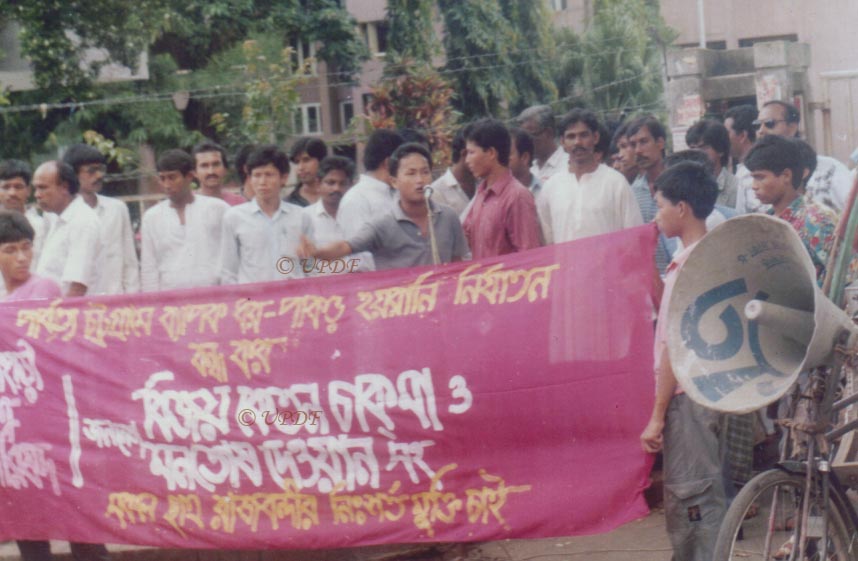
After the mass movement began under Prasit Khisha’s leadership, the JSS hardly needed to organize any further movements of their own. Riding this wave of popular mobilization, they reached a compromise with the government. On 10 August 1991 the JSS declared a unilateral ceasefire—although, in truth, before this announcement they had not managed to wage any major, medium-scale, or even minor battles against the Bangladesh Army. The government eagerly accepted the ceasefire and suspended operations against the Shanti Bahini.
From then on, rounds of political dialogue and ceasefire extensions between the government and the JSS continued. Typically, warring parties use ceasefires to rebuild strength and prepare for renewed conflict. But the JSS leadership did no such thing. During this period of ceasefire, they organized no movement, nor did they prepare for future war or struggle. Even when unity among all Jumma forces was essential to pressure the government before signing an agreement, Santu Larma, in a short-sighted move apparently aimed at clearing the way for his own surrender, triggered divisions among the Hill Students Council, Hill People’s Council, and Hill Women’s Federation.
Not only that, on 10 June 1995, at a public gathering in Dudhukchara of Logang in Panchhari, he opposed the movement and declared: “One cannot achieve autonomy by firing slingshots or blocking roads.” His statement sparked intense public backlash at the time. Many—including Pradip Lal and Kusum Priyo Chakma—publicly criticized Santu Larma’s remarks. (Some believe that after his surrender, Santu Larma had the two killed out of revenge for this criticism.)
As noted earlier, after declaring the unilateral ceasefire in 1991, the JSS did not undertake any further movement. Through a series of dialogues, they finally signed the “historic peace accord” with the Awami League government on 2 December 1997. This, in brief, is the background leading to the signing of the CHT Accord.
Looking back today, it becomes clear that without the enormous wave of student-mass mobilization under Prasit Khisha’s leadership at that time, the JSS would never have been able to sign their cherished “historic agreement,” and their fate would likely have been tragically grim. This article has been written not to claim any credit for the UPDF leader, but to present the true historical facts to the present generation.
(4 December 2025)
*Source : UPDF Facebook page.
————-