Satyadarshi Chakma
Everyone would agree, without hesitation, that military rule always stands in the way of a country’s development, prosperity, and progress. That is why, in country after country, people have fought and struggled against military rule for democracy. The people of Bangladesh, too, have a long and bitter history of military rule and struggles against it.
In Bangladesh, military rule has come at times through the direct imposition of martial law, at times through authoritarian rule by military leaders dressed in civilian clothes, and at other times through military-backed civilian caretaker governments. But regardless of the form or guise in which it has appeared, military rule has been a curse for democracy and development. That is why people oppose it.
The question now is: if military rule is an obstacle to development and social progress, then why is development in the Chittagong Hill Tracts being discussed while maintaining a massive military presence and military rule and control? Isn’t that a contradiction? Is it really possible to establish genuine democratic governance and development in the rest of the country while maintaining military rule in one region? Bangladesh’s history over the past 55 years bears witness to the fact that it is not.
Military rule in the Chittagong Hill Tracts is not merely an obstacle to the development of this region; it is also an obstacle to the development of the entire country. Just as if oxygen is not supplied—or is supplied inadequately—through the bloodstream to a distant part of the body, such as a hand or foot, gangrene, ulcers, and cancer will inevitably develop there, ultimately causing the affected person’s death. Alternatively, the hand or foot would have to be amputated to save the person. Likewise, if the oxygen called democracy does not reach the Chittagong Hill Tracts, the consequences will not be good in the long run.
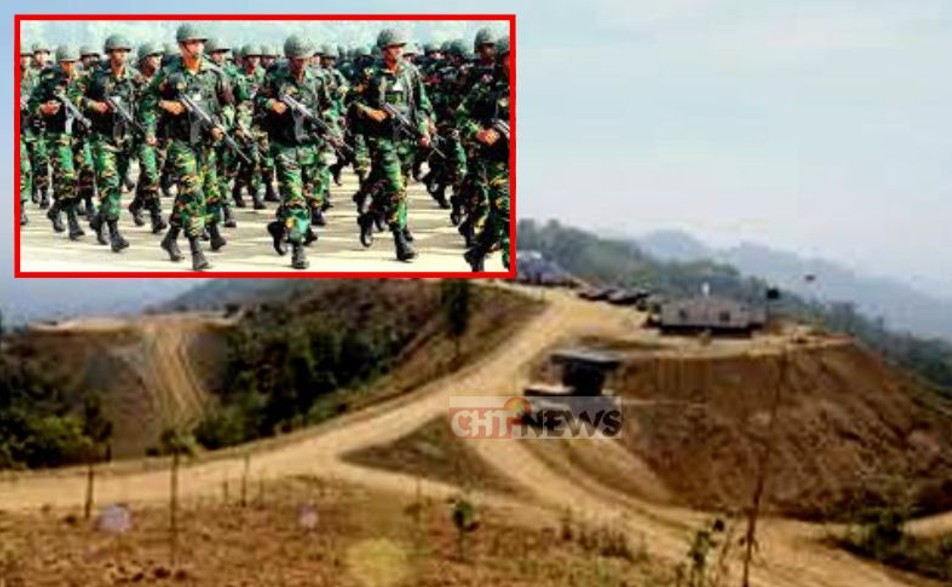
One argument made in favor of a military presence in the Chittagong Hill Tracts is that the army needs to be there to protect the country’s independence and sovereignty. There can certainly be a military presence in the hills, just as there is in other parts of Bangladesh. But why should the military control people’s everyday lives? Why should there be military rule? Why should the entire area be covered with military camps—as if some foreign country or enemy would attack us at any moment? Why should military operations, house searches, and harassment be carried out selectively and repeatedly in indigenous Jumma villages? A military presence and military rule are not the same thing. The people of the Chittagong Hill Tracts do not oppose the presence of the military; they oppose military rule and military control. And they do so for entirely reasonable and logical reasons.
We know that, in response to the questions above, the military or their subservient supporters will say that such measures are necessary to suppress terrorism. But it hardly needs to be said that this explanation is entirely deceptive and misleading. A detailed discussion of this issue would make this article much longer. Here, it is suffice to say that the root of all the problems in the Chittagong Hill Tracts today is the absence of a democratic environment and the existence of absolute military rule. Even after the armed struggle ended through the 1997 Chittagong Hill Tracts Accord, the same situation still prevails. The Chittagong Hill Tracts are still viewed through the lens of counterinsurgency. The army remains the undisputed authority here.
They are also judging the establishment of a college in Sajek from this so-called counterinsurgency perspective. They believe that if the army does not control the college, political parties in the hills—and, more explicitly, the United People’s Democratic Front (UPDF)—will establish dominance there. The educated students and young people of Sajek will become politically conscious, and that will create a challenge for the military.
In reality, this is merely a delusion on the part of the military. They are mistaking a rope for a snake and making a mountain out of a molehill. They are looking at the entire issue the wrong way. Like the protagonist of Rip Van Winkle, their thinking and consciousness remain stuck in the distant past, while the country, society, and world have moved far ahead.
The fundamental point is that national security cannot be ensured in any region through military repression. The extreme use of military force by West Pakistan during the period before 1971 in Bangladesh is proof of this. The more you try to suppress the legitimate rights of a region’s people through military means, the stronger their desire and efforts for democracy and liberation will become. Democracy, progress, and freedom can never be stopped through military means. Is the army able to prevent the opening of the college in Sajek by using force? When people have nowhere left to retreat, they are compelled to fight desperately for their survival. And whenever they unite and fight, they cannot be suppressed by any means. History has demonstrated this truth time and again.
To return once more to the point with which I began: the military rule prevailing in the Chittagong Hill Tracts is an obstacle to development not only in the Hill Tracts but throughout Bangladesh. As long as military rule continues in the hills, genuine democracy and development will not be possible—not only in the hills, but in Bangladesh as a whole.
“When those who are below us pull us down, we too will descend. Those whom we leave behind will obstruct our progress forward.”
It would be beneficial to everyone if the country’s leaders kept these words of Rabindranath Tagore in mind.
(August 11, 2026)
———